
France Just Raised the Art Provenance Bar. Why Should the US Art Market Pay Attention?
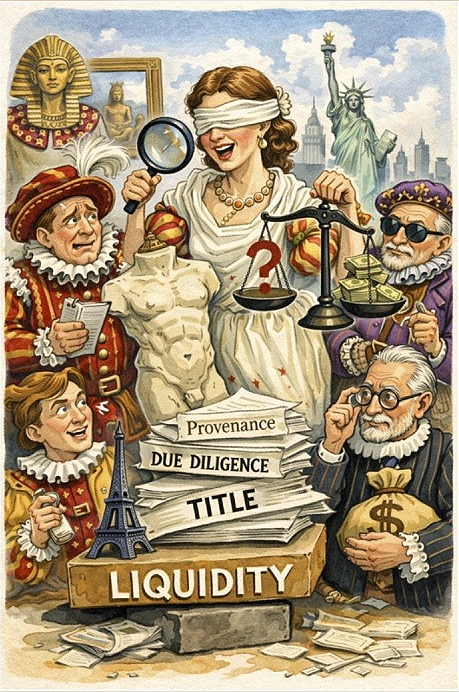
By Polina Ivko
France just raised the bar on provenance expectations for art market players everywhere. If you collect, appraise, advise or run a museum in the United States, read on and pay attention.
The sentence I keep coming back to as I write is “A valuation without marketable title is a mere guess with a fancy letterhead”. That is not rhetoric. It is not where practice is heading. It is where it is already at, especially in New York where I am based. If you are not on top of provenance issues, there is no time like now to catch up and do it fast.
By preparing a comprehensive provenance research guide for public institutions, the French Ministry of Culture has put government weight behind the idea that provenance research is not an optional scholarly exercise. When a major cultural jurisdiction formalizes due diligence in this fashion, it changes what looks reasonable everywhere else. It also gives claimants, journalists, insurers, lenders, consignees, regulators and other art market players an instruction manual. What did you do? And most importantly, can you show your work?
In the United States, we still rely heavily on self-regulation. Many institutions do excellent work. Many do not. (You know who you are.) The gap in this jurisdiction is not just ethical. It is financial, legal, and reputational.
Why does this matter right now to the U.S. art market, you ask? The U.S., and especially New York, has long been the hub of high stakes art and collectibles transactions. This is where provenance due diligence is not a mere suggestion, it is a requirement. We see increasing repatriations announced through the press. Looking at you, Manhattan District Attorney's Office. We see heightened scrutiny of antiquities when they are consigned to reputable auction houses. Looking at you, Christie's . We see museums professionalizing provenance as a leadership function, including hiring senior legal talent to run or support provenance initiatives. Looking at you, The Metropolitan Museum of Art.
The legal infrastructure on this side of the pond is straightforward. In New York and many other jurisdictions, you cannot pass good title to a stolen object. Good faith does not cure a theft no matter how you slice it. In my practice, I’ve observed provenance issues drive everything that follows in a collector’s or a museum’s portfolio.
So, what does this mean for each part of the art market ecosystem? I break it down below.
Museum directors and your trustees, treat your provenance records as an essential part of your governance. If your institution receives a claim, have no doubt that it will be judged on process as much as outcome. A thin provenance file can and will become a headline. However, a well-documented risk based process of assessing provenance of your collection can become a reliable shield.
Collectors and advisors, provenance is your best liquidity premium. Weak documentation will likely shrink your buyer pool (even in private sales), financial lenders, and trigger insurance friction. Even when nothing is seized, serious art market players have long started discounting uncertainty.
Appraisers, I am concerned about you the most. Do not make a mistake of forgetting that an appraisal is not just about comparable sales. It is about what can actually be sold, donated, bequeathed and insured in the real world. If title is questionable, marketability is compromised. If marketability is compromised, value is not what your label may say. Do not gloss over this.
Three things to do this week:
1. Tighten your intake and output processes for gifts and acquisitions. Consider risk tiering as high risk categories require deeper due diligence.
2. Standardize your documentation infrastructure. Ensure that your due diligence paperwork can be understood by everyone outside your department. Future teammates should not have to reconstruct the backstory of the object.
3. Align valuation with provenance reality of today. Do not be a rookie and let the appraisal float above the title analysis.
If a short form provenance diligence checklist would be useful for your team, message or email me and I will have it sent to you. Adwar Ivko is here to fulfill all your provenance and due diligence needs.